Rebuilding After the Fires: The Insulation Spec That Beats Code (and Why You Want It)
Wildfire Rebuild Insulation Code

If you lost a home in the Old Trails, Autumn Lane, or Fairview fire, you're about to rebuild under a very different rulebook than the one your old house was built with. A 1978 rambler in Nine Mile Falls was insulated to 1978's expectations, or to nobody's. Its replacement has to meet today's Washington State Energy Code, one of the most demanding residential energy codes in the country.
Most rebuild conversations treat that as a burden: "code upgrades" as a line item to argue about with the adjuster. This post makes the opposite case. The code is the floor, the walls are open exactly once, and the gap between meeting the minimum and beating it is the cheapest performance you will ever buy for this house. Here's the rulebook, the spec, and the reasoning.
Which code applies to your rebuild
The short version: the code in effect when your permit is issued, not the code your old house was built under. For Spokane County rebuilds permitted now, that's the current Washington State Energy Code (the 2021 WSEC, as amended), alongside the current building and residential codes. Spokane County has been clear in its wildfire rebuild guidance that replacement homes are new construction in the eyes of the permit office, even on an existing foundation.
What that means in insulation terms, roughly: R-49 to R-60 ceilings, high-performance wall assemblies (with credit options that reward continuous insulation), insulated slabs and floors, tight air-leakage targets verified by blower-door testing, and efficient ventilation. The WSEC also works on a credit system: builders choose from a menu of energy options to earn required points, and insulation and air-sealing upgrades are among the cheapest credits on that menu, which matters when the alternative credits are expensive mechanical equipment.
Two practical notes for fire families. First, your insurance policy may include code-upgrade coverage (often called ordinance or law coverage), which exists precisely to pay the difference between rebuilding what you had and rebuilding what today's code requires. Ask your adjuster about it directly, and get the insulation scope written against the current WSEC, not against your 1978 walls. Second, your builder's energy-code paperwork (the WSEC compliance forms and the insulation certificate) is documentation you want copies of; it feeds the appraisal and the eventual resale.
The spec that beats code, and what each upgrade buys you
We covered why cheap bids fail in New Construction Insulation: Why the Cheapest Bid Costs You for 50 Years; this is the rebuild-specific version, in the order the house gets built.
Air sealing beyond the target, while everything is open. The code sets an air-leakage limit verified by blower-door test. Beating it isn't exotic; it's sealing top plates, penetrations, can lights, rim joists, and the attic hatch carefully while they're all exposed, which happens exactly once. Every leak sealed now is heat kept in January, smoke kept out during the next fire season, and moisture kept away from the attic, which is where Spokane's mold problems start. A tight house also holds filtered air during smoke events, which every family that spent August breathing through box-fan filters will appreciate.
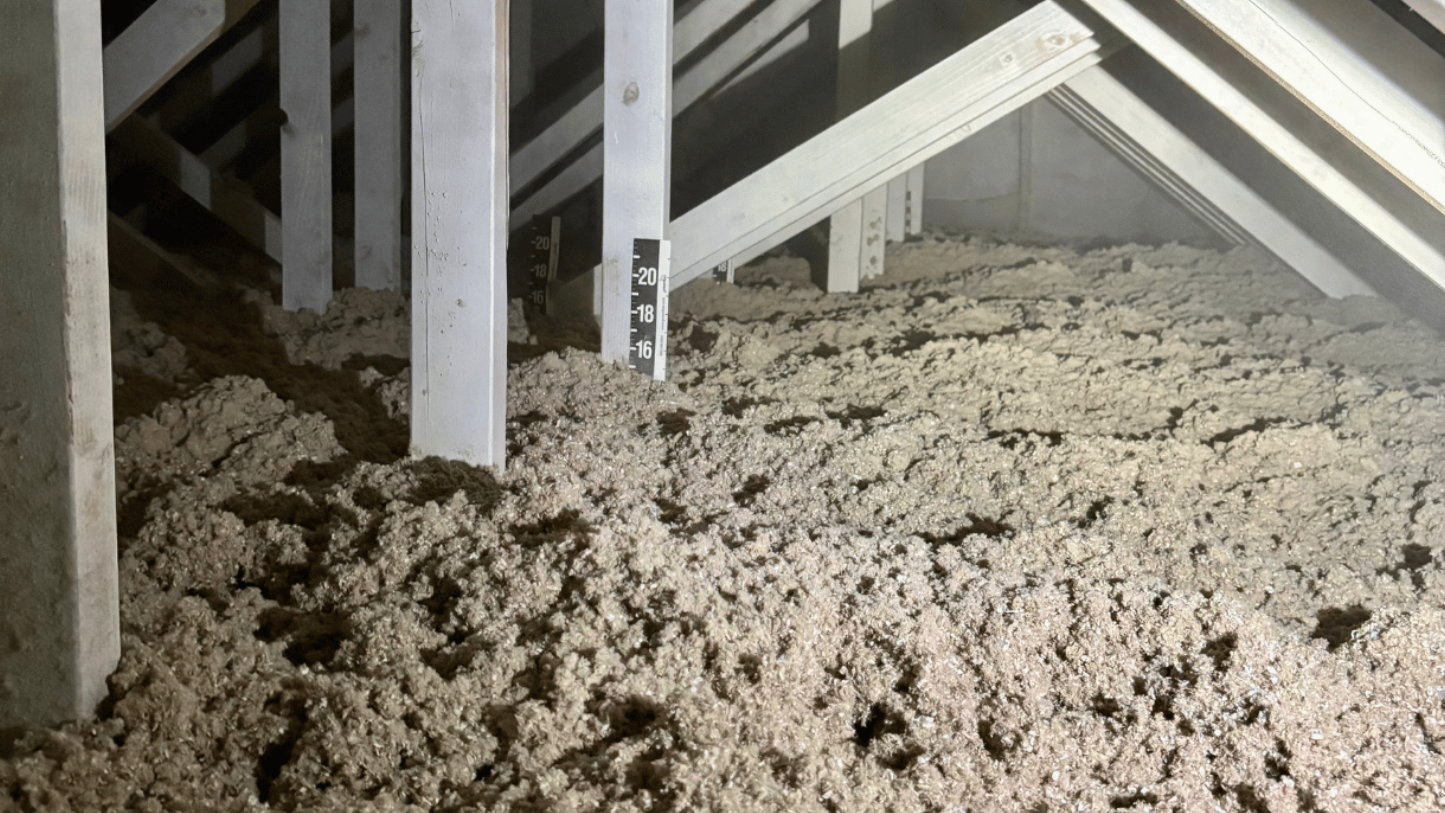
Ceilings at R-60, not the minimum. The blower is on site either way; the material difference between meeting the ceiling requirement and topping out at R-60 is small on build day and permanent afterward. We blow Clean Fiber cellulose: recycled, borate-treated, and naturally resistant to mold, rodents, and fire. In a county that just watched wind-driven embers work through 900 structures, insulation that doesn't add fuel to the attic is not a small detail.
Continuous insulation on the walls. The WSEC's credit menu rewards it, and physics agrees: rigid foam over the framing breaks the thermal bridge at every stud, which is where code-minimum walls quietly leak heat. It's also the upgrade that's genuinely impossible to add later without residing the house.
Rim joists and floors done as a scope, not a stuffing. Sealed and insulated rim joists are the difference between warm floors and the cold ring that haunts split-levels. On crawlspace and daylight-basement rebuilds, get the floor assembly specified in writing.
Sound batts while the interior walls are open. Not an energy item, but a rebuild is the one chance to give bedrooms, baths, and laundry walls the quiet the old house never had. Cheap now, impossible later.
Ember-resistant venting: the fire lesson written into the attic
Here's the part of the spec that's specific to rebuilding in a place that burns. Attics have to ventilate, but the vents that breathe for your insulation are also the openings embers use. Post-fire assessments, in Spokane's fires and across the West, consistently find that wind-driven embers entering through soffit, gable, and ridge vents are a leading way homes ignite, sometimes hours after the fire front passes.
The fix is not less ventilation; it's smarter openings. Ember-resistant venting means vents with fine corrosion-resistant metal mesh (1/8-inch openings, the WUI standard) or listed ember- and flame-resistant vent products at the soffits, gables, and ridge, along with the same discipline anywhere the envelope breathes. Pair that with non-combustible gutter guards and metal flashing details at the eaves, and the attic keeps breathing without inviting the next fire in. If your rebuild is in one of the county's wildland-urban interface areas, some of this may be required; even where it isn't, it's cheap insurance bolted onto vents you're buying anyway, and it's exactly the kind of mitigation detail insurers are starting to price into premiums under Washington's proposed wildfire-preparedness programs.
One coordination note: ember-resistant vents have slightly different airflow characteristics than bare louvers, so the ventilation math (net free area against attic size) should be run with the actual vent products in the spec. That's a five-minute calculation we do as part of the insulation package, and it's how you avoid the too-tight attic that grows condensation problems.
Why beat the minimum? The arithmetic
Take the long view the house will take. The delta between code-minimum insulation and the spec above on a typical rebuild is usually a low-four-figure number, some of it potentially covered by code-upgrade insurance provisions and utility rebates through Avista, Inland Power, Modern Electric, and Vera Water & Power. The return is a heating and cooling load meaningfully below the code-minimum house next door, every month, for the life of the building, plus a quieter interior, a mold-resistant attic, a documented energy spec for resale, and vents that don't accept embers.
And unlike nearly everything else in the budget, this is the improvement with a one-day window. Countertops can be upgraded in year five. The wall assembly can't.
The rebuild timeline reality
Every fire rebuild in the county is on roughly the same schedule, which means framing crews now, and a wall of drywall-stage projects hitting insulation contractors at the same time this winter and spring. Builders who lock their insulation sub at framing stage keep their schedule; builders who call at drywall stage join a line. If you're an owner-builder, put the insulation bid on your critical path now, and get it itemized: assemblies, R-values, air-sealing scope, vent products, and the WSEC credits it earns, in writing.
We bid rebuilds room by room through our New Construction Insulation Bid form: walls by cavity depth, floors, vaulted ceilings, attic blow-in to R-49 or R-60, sound batts, rim joists, and air sealing, with job-site photos so the bid matches the framing. Financing is available.
Rebuilding in Spokane County or North Idaho? Get the spec priced: insulationspokane.com or (509) 879-0495.
Serving Spokane, Spokane Valley, Liberty Lake, Cheney, Airway Heights, Medical Lake, Mead, Colbert, Deer Park, Nine Mile Falls, Suncrest, Post Falls, and Coeur d'Alene.
Everything Attic. Except Bats. We're Terrified of Bats.
Follow us