Halloween Edition — The 5 Scariest Things We've Found in Spokane Attics
Nobody goes in the attic. That's the problem.
You know every inch of your kitchen. You could find the one squeaky stair in the dark. But the biggest room in your house, the one sitting directly above your bed, you have probably looked into exactly once, through a hatch, with a phone flashlight, for about four seconds.
We go into Spokane attics every day. Fourteen years, thousands of hatches. Most are fine. Some are dusty. And a few make the whole crew go quiet for a second before somebody says "well, there's your smell."
Here are five of those. Every one is a real local job. We've stripped the names and addresses, kept the photos, and left the towns in so you can check whether your neighborhood has made the list.
1. The bathroom that exhaled into the attic for 22 years
[Photo: attic-mold-remediation-chattaroy.jpg. Caption: Black mold across the roof sheathing above a bathroom in a Chattaroy home. The fan duct ends two feet short of the roof vent.]
A family north of Spokane called about a musty smell that showed up every October when the furnace kicked on. They had already repainted the hallway ceiling twice. The attic hatch was in the bathroom closet, which turned out to be a clue.
The bath fan duct ran about three feet across the attic and stopped. Every shower since the late 1990s had been pumping warm, wet air directly onto the underside of the roof. The sheathing above the bathroom was black for a ten-foot radius, the nails were rusted, and the insulation under it was damp enough to wring out.
Two-day fix: containment, remove the insulation, antimicrobial treatment on the framing and sheathing, finish the fan duct to daylight, air-seal, and re-blow Clean Fiber the next morning. The October smell did not come back. More on attic mold here.
Attic Rating: 4 out of 5 flashlights dropped.
2. The "gravel" in the 1962 rancher
[Photo: vermiculite-insulation-removal-millwood.jpg. Caption: Vermiculite close-up in a Millwood attic. The shiny gold-gray flakes are the tell.]
A couple selling a mid-century rancher in the Valley got a note from the buyer's inspector: "possible vermiculite in attic, recommend testing." They had lived there eleven years and thought it was pea gravel somebody poured up there for soundproofing. Their kids had used the attic for a fort.
Vermiculite is a mineral that puffs up like popcorn when heated. Most of what was sold in the U.S. between the 1940s and 1990 came from a mine in Libby, Montana, about three hours from Spokane, and that mine's ore was contaminated with asbestos. Spokane and Coeur d'Alene were close enough to the source that we see it in a startling number of houses from that era.
Testing came back positive. Full abatement: negative-air containment, suited and respirator-fitted crew, HEPA vacuum removal to sealed bags, clearance testing, then fresh cellulose. The sale closed three weeks later. The Zonolite Attic Insulation Trust reimbursed a portion of the cost, which most homeowners have never heard of. Here's how to check your own attic.
Attic Rating: 5 out of 5. Nobody goes up without a suit.
3. The mouse interstate
[Photo slot: rodent-contaminated-insulation-removal-cheney.jpg. Caption: Mouse tunnels and droppings in fiberglass batts in a Cheney attic. The dark trails are the commute.]
A homeowner near Cheney heard scratching in the ceiling every night at about 9:30. Pest control set traps, caught six mice in a week, and declared victory. The scratching stopped. The smell did not.
When we opened the hatch, the fiberglass looked like an aerial photo of a highway system. Tunnels ran from the soffit on the east side to the kitchen wall on the west, with a cloverleaf interchange above the pantry. Decades of droppings had soaked into the batts, and in one corner there was a nest the size of a basketball built from insulation, dryer lint, and what used to be a Christmas stocking.
Here is the thing nobody tells you: catching the mice does not fix the attic. The urine and droppings stay in the insulation, the smell gets pulled into the house every time the furnace runs, and the scent trails invite the next generation in. The fix is removal with sealed vacuums, sanitizing the framing, sealing every entry point the trails led to, and fresh cellulose. Full write-up on rodent cleanup here.
Attic Rating: 3 out of 5. Would have been a 4, but the stocking was festive.
4. The white glove test
[Photo slot: smoke-damaged-insulation-ash-glove-spokane.jpg. Caption: One swipe across the top of the insulation in a Spokane attic, a year after the wildfire smoke.]
This one was a Spokane home, a full year after a heavy smoke summer. The homeowner had done everything right. Air purifiers in every room, furnace filter changed monthly, windows open on every clear day. The house smelled fine from October to March. Then the first warm week of April, the whole place smelled like a campfire again.
We put a white glove on and wiped the top of the attic insulation once. It came back gray. The entire attic had a layer of fine ash sitting on the blown-in, heaviest under the roof vents where the smoke had been pulled in. Nothing in the house could reach it, because the attic is outside the part of the house the furnace filter touches.
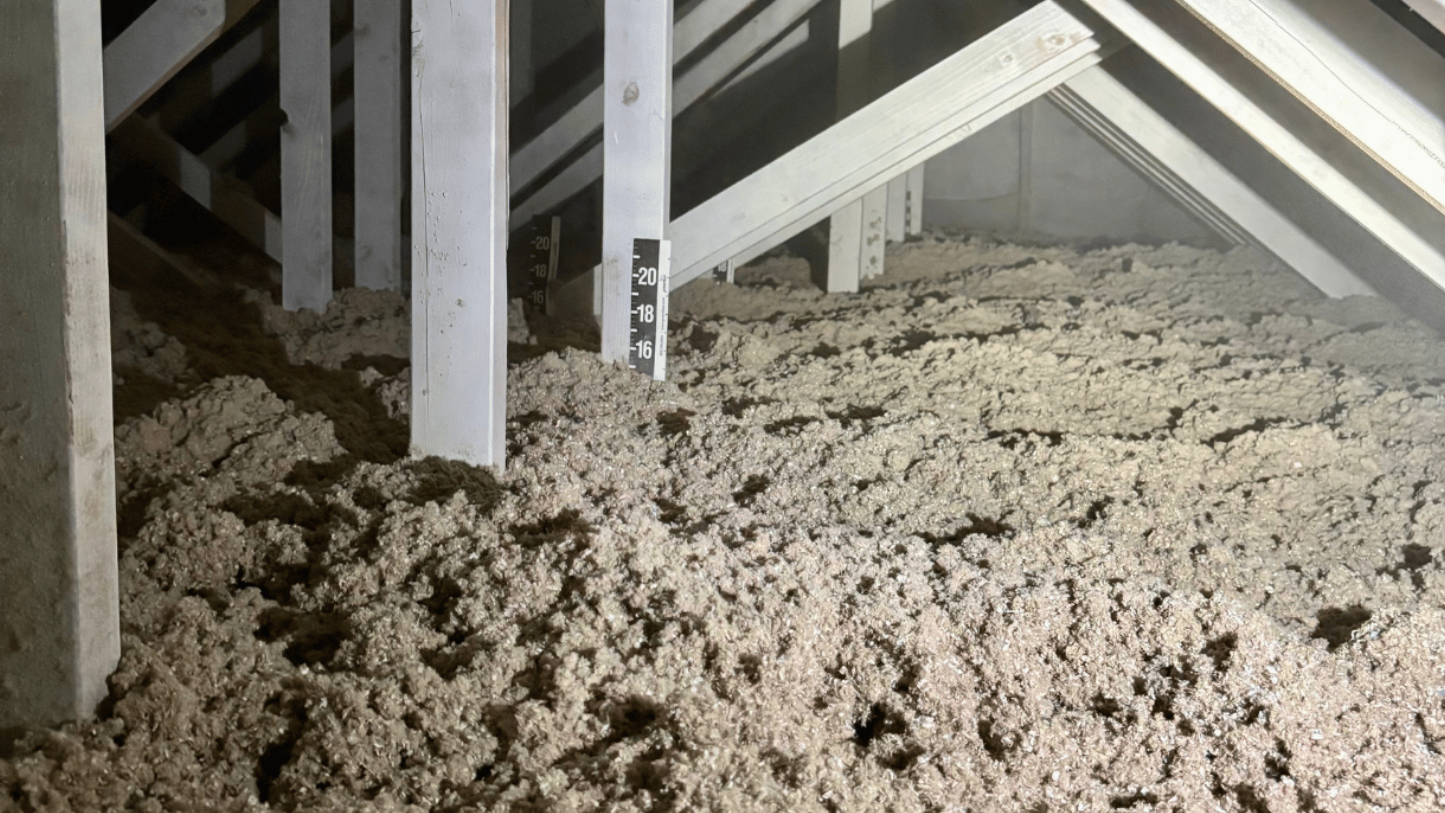
The reason it smelled fine all winter is that cold insulation barely off-gasses. Warm it up in spring and everything stored in it releases at once. Removal, Vital Oxide treatment, air sealing, and re-blow fixed it in a day. Here's the full explanation of why smoke hides in attics.
Attic Rating: 2 out of 5 on the gross scale, 5 out of 5 on the "I thought it was gone" scale.
5. The smell nobody could name
[Photo: attic-insulation-removal-newman-lake.jpg or similar removal shot. Caption: What "we've tried everything" looks like from the hatch.]
A Liberty Lake family had a smell in the upstairs hallway that three different companies had failed to find. Not mold, said the mold guy. Not sewer gas, said the plumber. Not electrical, said the electrician, though he did find a scorched outlet that was its own problem. The homeowner described it as "sweet, but wrong."
The attic answered it in about ninety seconds. A raccoon had gotten in through a loose gable vent a couple of years earlier, lived up there for a season, and left. What it left behind was a latrine in one corner of the insulation and, under a roll of leftover batt, the raccoon. Warm attic in summer, cold in winter, and a smell that came and went with the seasons for two years while everyone looked in the wrong rooms.
We sealed the gable vent, removed everything down to the drywall in that section, sanitized, and re-insulated. The homeowner's only question afterward was why nobody had just opened the hatch.
That is usually the question.
Attic Rating: 5 out of 5. The crew still talks about it.
The one thing we will not go up for
[Photo: Gus the sheep mascot peeking up through an attic hatch, eyes wide. Square crop for the social graphic.]
Mold, fine. Asbestos, we suit up. Mice, raccoons, forty years of droppings, wet fiberglass you could wring out, an attic that smells like a campfire in April: we have a process for every one of them and we'll show you the photos.
Bats, no.
If you open your hatch and something flaps, close it, call a wildlife company, and call us after they've finished. We'll handle the cleanup. We will not handle the bats. We have a sheep on our logo for a reason, and the reason is that sheep are not brave.
Share this with the friend who swears their attic is fine.
Find out what's in yours
Every story above started the same way: a smell, a sound, or a note from an inspector, followed by months of guessing. Every one ended the same way too: somebody finally opened the hatch and looked.
An attic inspection takes about an hour. You get photos of what's up there, a written report, and a single fixed price if anything needs to be done. Most of the time the answer is "dusty, but fine." When it isn't, you'll want to know before the buyer's inspector does.
Book an attic inspection at insulationspokane.com/inspections or call (509) 879-0495. Selling? The Home Sale Hotline is (509) 351-2811.
What's the worst thing you've found in an attic? Tell us in the comments. Wrong answers only.
Pacific Insulation & Mold Remediation has served Spokane and Coeur d'Alene since 2012 with over 135 five-star Google reviews. Licensed and insured: WA Lic. #PACIFIL886KH, ID Lic. #RCE-47538. Make sure your contractor is local, licensed and insured at LNI.WA.GOV.
Everything Attic. Except Bats. We're Terrified of Bats.
Follow us