Shop, Pole Building, Garage &
Barndominium Insulation
An uninsulated shop in the Inland Northwest is an expensive way to warm the outdoors. Bare steel sheeting has an R-value of roughly nothing, so every BTU your heater makes heads straight through the wall, and every cold snap turns the ceiling into a rain machine. Whether you're finishing a new post frame building in Deer Park, converting a pole barn near Chattaroy into a barndominium, or finally making the garage in Spokane Valley usable in January, the fix is the same: the right insulation, in the right assembly, with condensation handled on purpose instead of by accident.
We insulate shops, pole buildings, garages, post frame structures, and barndominiums across Spokane County, the Palouse, and North Idaho. Here's the straight version of what works in a metal building and what doesn't.
Why Insulate Your Shop? The Real Reasons
- Heat you pay for stays inside. An insulated shop holds 50–55°F on a fraction of the fuel an uninsulated one burns, and a properly insulated ceiling is the difference between heating the shop and heating the sky.
- Condensation stops raining off the roof. Warm moist air on cold steel means dripping purlins, rusty tools, and wet drywall. Insulation with a proper vapor strategy keeps the steel above the dew point.
- Your tools and equipment last longer. Stable temperature and humidity protect cast iron tables, electronics, welders, and vehicle finishes from rust and corrosion.
- You can actually work out there in January. A shop you can heat in an hour gets used all winter. A shop that takes all day to warm up becomes a storage unit from November to March.
- Summer works too. Insulation and a radiant barrier keep a metal building from becoming an oven during Spokane's 100-degree stretches.
- The compressor, the grinder, and the band saw stay in the shop. Insulated walls are quieter walls, in both directions. Your neighbors hear less, and your ears take less of a beating inside.
- Livestock, hay, and stored crops are protected. In ag buildings, condensation control is the difference between dry hay and moldy hay.
- Resale and appraisal. A finished, insulated shop is one of the highest-demand features in the Spokane County rural market. An uninsulated one is a line item the buyer plans to fix on your dime.
- Barndominium code compliance. The moment a post frame building becomes a residence, Washington's energy code applies. Insulation designed in from the start beats retrofitting it after drywall.
- Fire resilience. After the August fires, it's worth saying: borate-treated cellulose and mineral wool don't add fuel to a building. Bare foam left exposed does, which is why assemblies and thermal barriers matter.
Climate Control
Soundproofing
Condensation
Frequently Asked Questions
What is the cheapest way to insulate a pole barn?
For buildings with a flat ceiling, a ceiling liner with blown-in cellulose above it delivers the lowest cost per R-value, with batts or rigid foam board on the walls as budget allows. Insulating the ceiling alone often cuts heating costs dramatically, because that's where most heat leaves.
Do I need a vapor barrier in my metal shop?
You need a vapor strategy, which in our climate usually means a vapor retarder on the warm (inside) face of the insulation, sealed air leaks, and insulation keeping the steel above the dew point. Skipping it is where dripping ceilings and rusty trusses come from.
How much insulation does a barndominium need?
Once it's a residence, Washington's energy code applies: think R-49 to R-60 ceilings, continuous insulation on steel-framed walls, and insulated slabs or floors. Design it in before drywall; retrofitting continuous insulation after finish is expensive.
Can you insulate an existing shop without tearing off the steel?
Usually, yes. Flat-ceiling buildings get a liner and blow-in. Open-to-the-roof buildings get spray foam on the underside of the sheeting or a hybrid assembly. We'll tell you which after we look.
Insulation Options for Shops and Pole Buildings
01
Blown-In Cellulose Above a Ceiling Liner
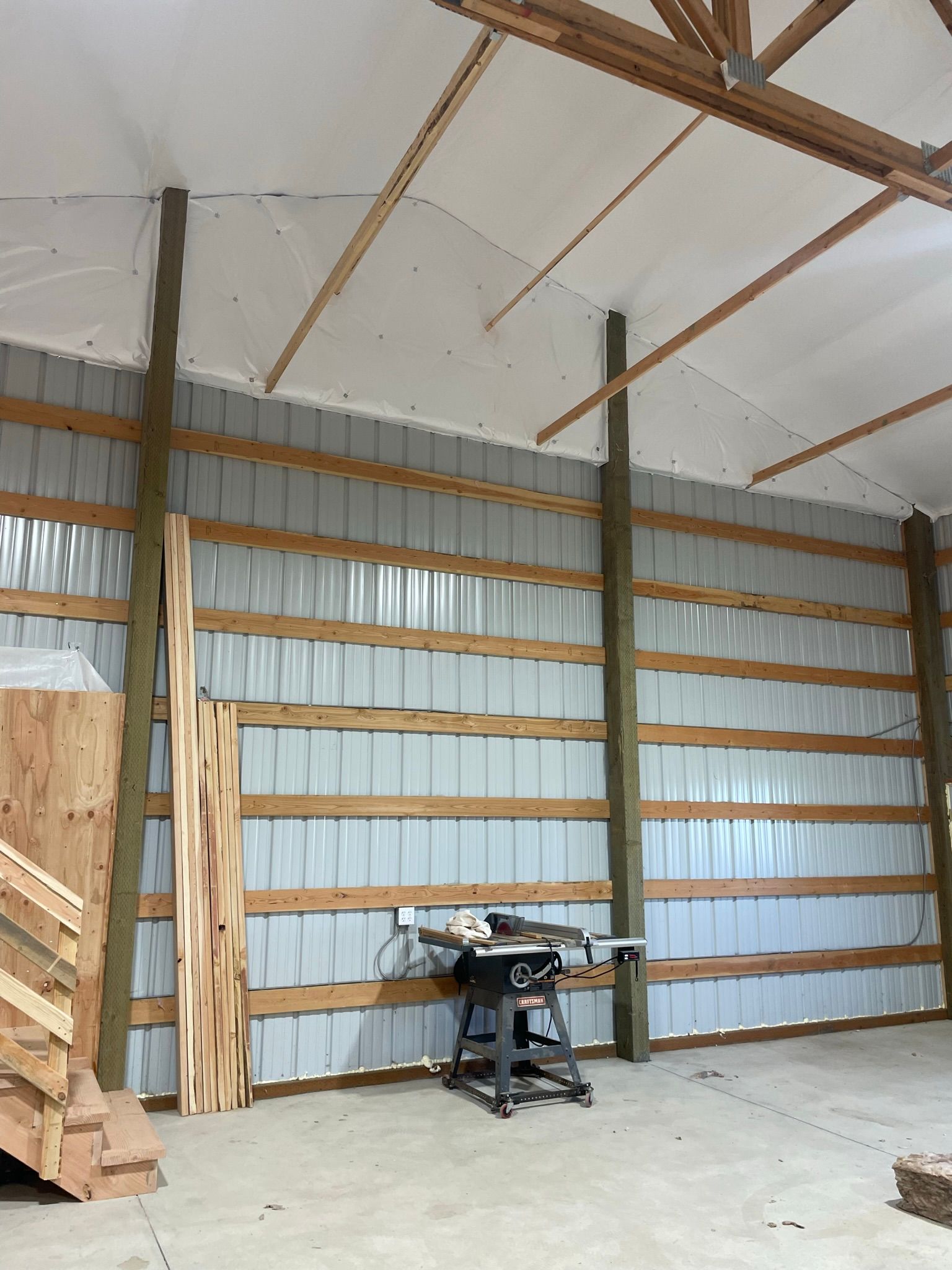
For any shop or pole building with a flat ceiling, this is usually the winner on cost per R. Install a steel or OSB ceiling liner, air-seal the penetrations, and blow Clean Fiber cellulose above it to R-49 or R-60. Recycled, borate-treated, and naturally resistant to mold, rodents, and fire, it turns the biggest heat-loss surface in the building into the best-insulated one, at a price that surprises most shop owners. This is our most-installed shop assembly, and it's the same insulation and blower we use on residential attics.
02
Rigid Foam Board for Shop Walls
Rigid foam board for a shop shines where you need continuous insulation and a cleanable surface: across girts on walls, under concrete, and as the thermal break layer over steel framing. Polyiso runs about R-6 to R-6.5 per inch, XPS about R-5, and EPS about R-4, and because the board runs continuous over the framing, it kills the thermal bridging that batts between girts can't touch. Foil-faced polyiso doubles as a radiant barrier and a vapor retarder when the seams are taped. One code note worth knowing before you DIY: exposed foam plastic generally needs a thermal barrier or an ignition barrier over it in occupied buildings, which is one of several reasons foam walls should be planned, not improvised.
03
Rockwool for Garages and Shop Walls
Rockwool for a garage earns its premium in three ways: it's fire-resistant to around 2,000°F, it doesn't hold water or feed mold, and it's one of the best sound-absorbing insulations you can put in a wall. For a garage with a wood stove, a welding corner, or a bedroom on the other side of the wall, mineral wool batts are the upgrade pick. Dense, friction-fit, and rodent-unfriendly, they also stay put in walls that get vibration from doors and equipment.
04
Reflective Radiant Barrier for Shops
A reflective radiant barrier in a shop does one specific job: it blocks radiant heat, which is most of what makes a metal building unbearable in July and what a bare metal roof pours down on you like a broiler. Foil barriers under the roof steel, or foil-faced insulation with an air gap, reflect the majority of that radiant load back out. Two things to know: a radiant barrier needs an air gap facing the foil to work, and it is a supplement to R-value in our climate, not a substitute. Spokane winters are won with insulation; the radiant barrier is the summer assist, and double-bubble foil alone is not an insulation plan.
Sources
- U.S. Department of Energy, Energy Saver: Insulation — R-value fundamentals and recommended levels by climate zone.
- U.S. Department of Energy, Energy Saver: Types of Insulation — batts, blown-in, rigid foam board, and spray foam compared.
- U.S. Department of Energy, Energy Saver: Radiant Barriers — how reflective barriers work and why they require an air gap.
- U.S. Environmental Protection Agency: Moisture Control Guidance for Building Design, Construction and Maintenance — dew point, condensation, and mold prevention in buildings.
- Radiant Barrier USA: Metal Building Insulation: Complete Guide — assemblies and condensation control in steel buildings.
- US Patriot Steel: Metal Building Insulation: Types, R-Values, and What Actually Works — per-inch R-values and thermal bridging in steel framing.
- CMI Insulation: Best Vapor Barrier Setup in Metal Buildings — vapor retarder placement in metal building assemblies.
- Washington State Building Code Council: Washington State Energy Code — residential energy requirements applicable to barndominiums.